Gameplay
Overview
Racing is contact-based and built around risk. Every craft carries two boost systems that pull against each other, bumping rivals off the track is encouraged rather than penalised, and the campaign is structured as runs where a bad race costs something. [1][2]
Fuse Games CEO Matt Webster has framed the design against the genre’s usual safety net: “It’s hard to have consequence when you’ve got a rewind button.” He cites Hades and Returnal as the structural influences. [2]
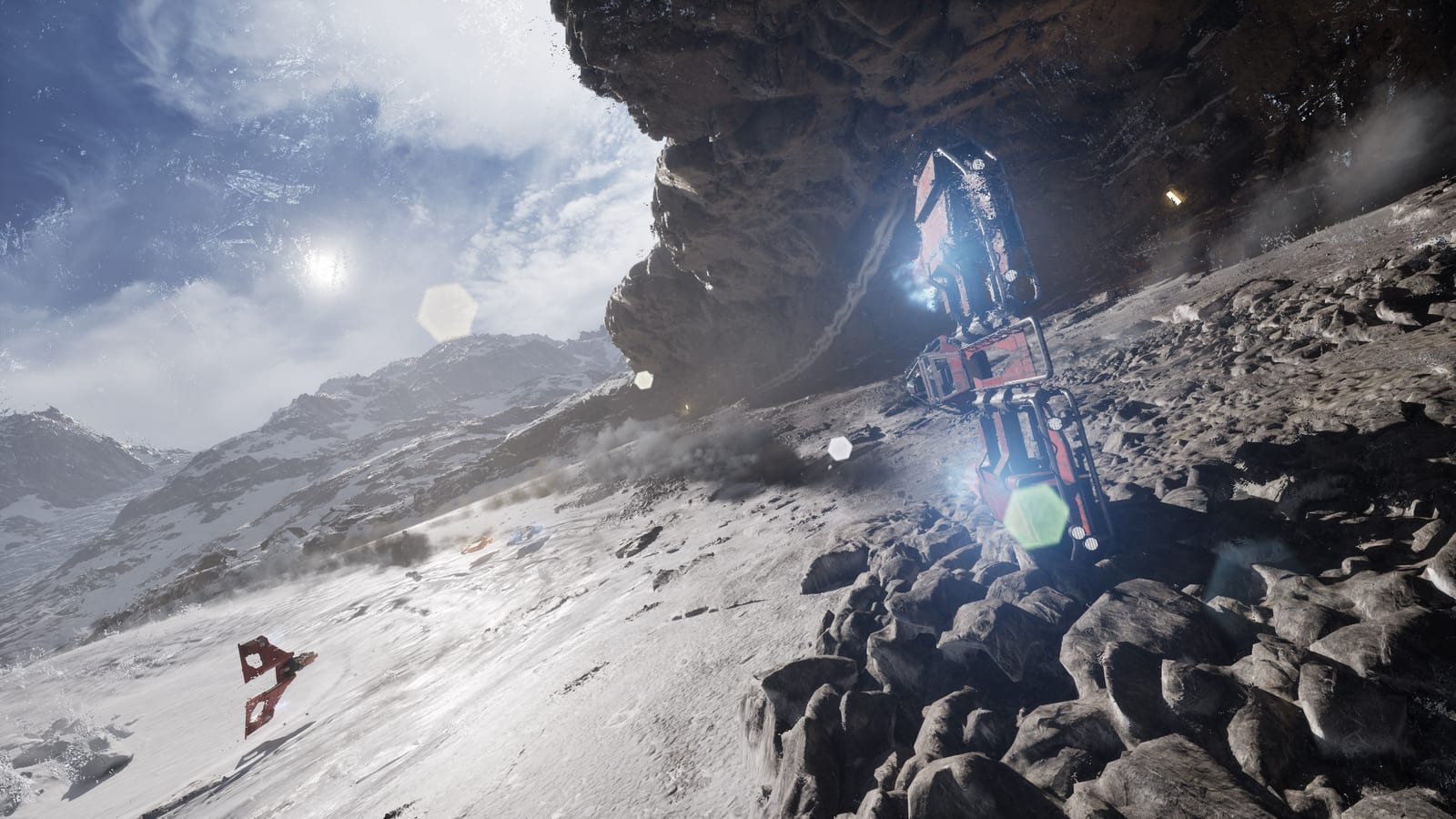
Boost
Two systems, used differently. [1]
- Afterburner. A brief boost, rechargeable and usable several times a race. Draws on the Battery.
- Ramjet. A much larger boost, enough to set up a takedown. Causes the craft to overheat.
The Ramjet is the high-risk option: it is described as giving “incredible boost” for takedowns while heating the craft, so it is the part of the design that turns a chase into a gamble rather than a straight speed increase. [1]
Chassis and Handling
Three chassis are described for the campaign, each handling differently and each carrying its own trait. [1][2]
- Landspeeder. Real weight to it, specialising in drifting around corners. Trait: Drift.
- Speeder bike. Great straight-line speed, harder to control around corners. Trait: Kinetic Burst.
- Skim speeder. Made for hard banking turns, and the hardest frame to control. Trait: Knife Edge.
Webster describes the skim speeder as handling “like aircraft”, and the reveal interview describes it rewarding “flowing lines and maintaining momentum, banking through corners and knife-edging through narrow gaps”. Speeder bikes are described as “fast and ferocious”. [2][3]
Podracers also feature, and Webster calls them the pinnacle of the vehicle list: eight to ten metres long and reaching 1,000 km/h. [2]
See Repulsorcraft for the classes and the named craft.
Handling and the Traction Model
Repulsorcraft in Galactic Racer have no traction model. Design Director Mark Bridges has described starting from one, as a wheeled vehicle would use, and abandoning it: [6]
We were using a traction model that is bound to the surface, but repulsorcraft do not lay their grip onto the ground based on the surface, they do it through technological means. By removing traction, we were able to explore a multitude of terrain types and gradients to build excitement and spectacle as well as challenge. But notably, when you remove traction, what does that unlock? Speed. A lot of speed.
Each class is still anchored to a real-world analogue. Game Director Bill Lane: landspeeders “need to drive like cars, mostly”, speeder bikes “like bikes, mostly”, and the skim speeder, invented with Lucasfilm Games, “needed to drive like a plane because that’s a real-world analogue”. He describes podracers as “essentially horse and chariot meets Formula 1”. [6]
Upgradeable Stats
Between races, base stats are improved. Four are named, alongside the chassis-specific traits above: [1]
- Afterburner
- Battery
- Cornering
- Ramjet
The higher the finish, the more upgrades can be applied. [1]
Builds and Status Effects
Worlds apply status effects that change how parts perform, so a build is tuned against where it is racing rather than in isolation. Webster describes players needing to understand how parts interact with conditions: avoiding heat in one place, deliberately leveraging overload in another, and putting together “synergistic builds”. [2]
Takedowns
Bumping rivals off the track is “actively encouraged to increase your chances to win”. The studio’s background is Criterion, where the team made the Burnout and Need for Speed series, and Secret Mode frames the trade directly: “The greater the risk, the greater the reward.” [1][4]
Tracks
Tracks carry branching routes rather than a single racing line. [3]
References
If information is missing, it has not yet been confirmed. Corrections are welcome.